
History
The Radical Communicators Network began in 2016 following Trump’s first election. Our community of movement and communications workers came together to share connections and resources for what was to come.
In November 2016, longtime comms strategist Shanelle Matthews was tucked away in a hotel room in Atlanta awaiting the results of the presidential election. She remembers that moment: “On my computer were two conditional statements I drafted for the Black Lives Matter Global Network—one that acknowledged that the Democrats who built the scaffolding for mass incarceration won and a second that Donald Trump would be our next president. I knew neither outcome would serve the interests of people living under deep conditions of domination, oppression, and exclusion in the United States—or in any region in which U.S. forces meddle.
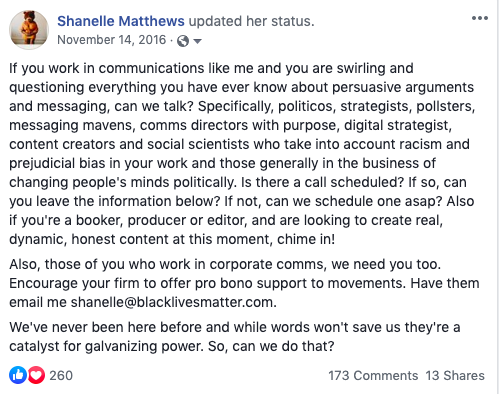
We all know the outcome of the election. Recognizing what we were up against and unsure of how to move, Shanelle reached out via a post on Facebook, asking for people to join her in an election post-mortem to determine what we wanted and needed: a network for grassroots communicators. RadComms was founded as a repository for our grief, angst, desire for connection, and collective thinking—a safe place to explore dilemmas like the one I faced on election night.
Since then, we have made meaning of the world together; applying lessons from movements’ past, adapting contemporary strategies to counter the prevailing conditions of white supremacy, corporate greed, climate destruction, and interpersonal violence today, and organizing for—at a minimum—a morally just and dignified future.”
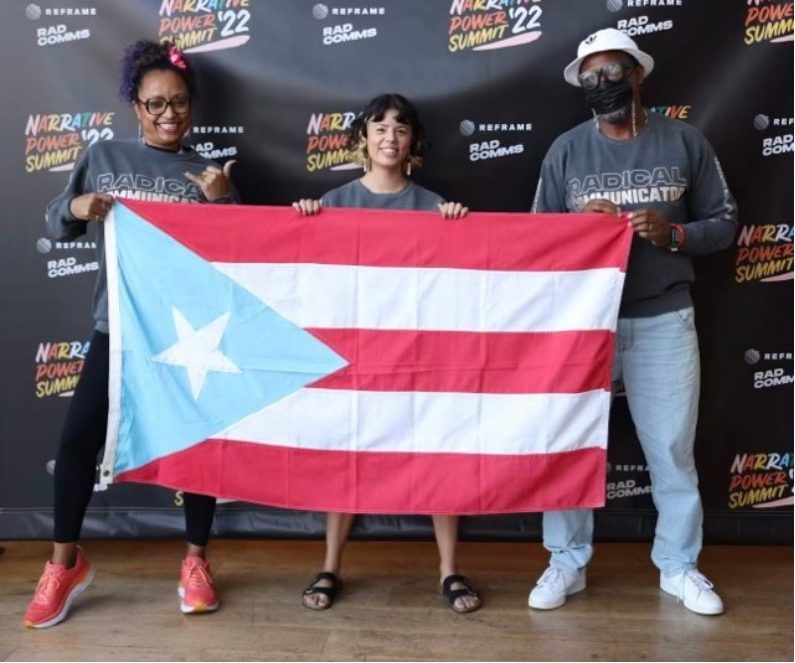
Today, the Radical Communicators Network (RadComms) is a community of practice for activists, organizers, and other change-makers working to build narrative power for social justice. RadComms is growing and strengthening the ecosystem of social-change communications by bringing together a global cohort of communicators to cross-pollinate conversations across a variety of movements, backgrounds, levels of experience, geographies, languages, and political associations and by radicalizing the field to focus on building narrative power thereby putting people closest to the oppression at the center of our efforts. In the years since our founding, our network has rippled to more than 5,000 people across almost every U.S. state and in at least 20 countries, illustrating a hunger for belonging and connectivity. Here’s why that’s important: Insurgent social movements, like the ones to which many of us belong, require networked communities that expand beyond local bounds to transform political opportunities into long-term social protest or change.
During movement moments like the 2020 summer uprisings in defense of Black lives, movements relied on existing complex infrastructure such as RadComms to disseminate information, mobilize support, inspire collaboration, and discuss emergent strategies. One example is the collaboration between RadComms, M4BL, and ReFrame to train hundreds of communicators on how to message #defundthepolice, which provided tactical training in two languages and proliferated abolitionist values into mainstream discourse. RadComms is organic and driven by people in the field. Network members come from a variety of movements, including those focused on gun violence, sexual violence and harassment, criminal-legal reform, reproductive justice, gender justice, income inequality, climate change, and immigrant rights.
Stories and storytelling are the backbone of an inclusive society. How they are told defines whose lives are valued and whose are not. That is why throughout history, the critical efforts of communicators whose work is rooted in shifting power dynamics towards a revolutionary, grassroots framework have changed hearts and minds, set political agendas, and transformed culture to create a more equitable society where more people live with dignity.